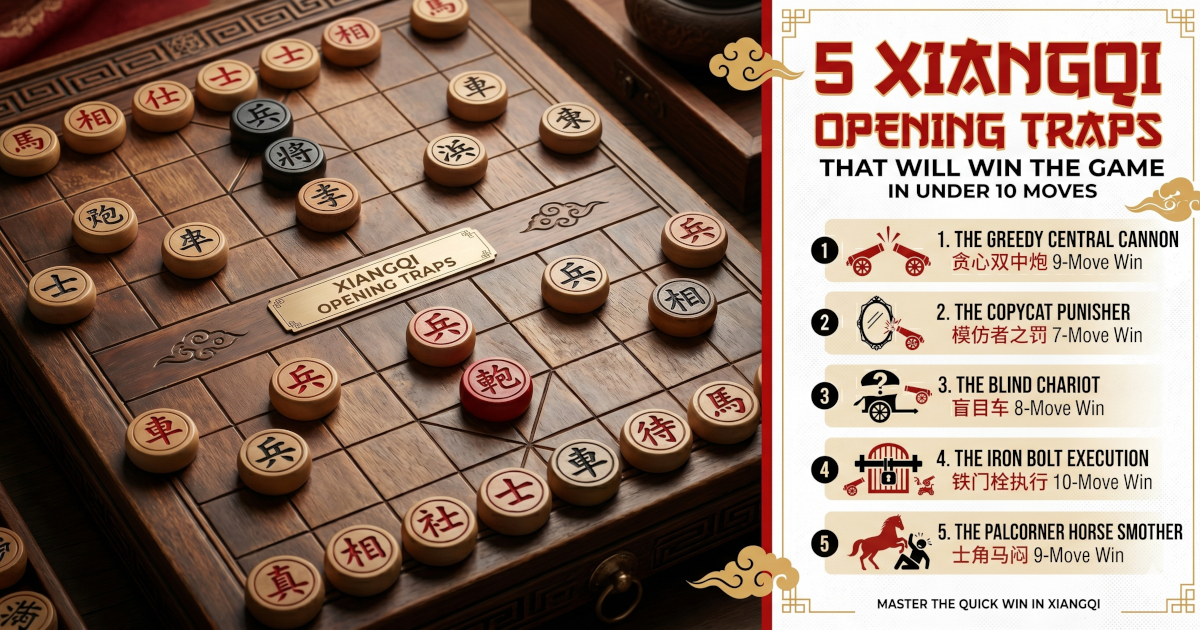
5 Xiangqi Opening Traps That Will Win the Game in Under 10 Moves
Table of Contents
- 1. The Greedy Central Cannon (The Unprotected Pawn Trap)
- 2. The Copycat Punisher (The Double Cannon Mate)
- 3. The Blind Chariot (The Cross-Palace Pin)
- 4. The Iron Bolt Execution (Tie Men Shuan)
- 5. The Palcorner Horse Smother (The Angle Ambush)
- Quick Reference Guide: Trap Summary
- Mastering the Minefield
If you are coming to Xiangqi (Chinese Chess) from a Western chess background, the first thing you will notice is the blistering, almost terrifying speed of the game. In regular chess, you have the luxury of spending the first dozen moves quietly building a pawn structure and developing your pieces behind a defensive wall. Xiangqi offers no such comfort. Because the Soldiers (pawns) are spaced out and the board is wide open from Move 1, heavy artillery can instantly cross the river. Thanks to the unique jumping mechanics of the Cannon (Pao) and the raw power of the Chariot (Ju), a single mistake in the opening can lead to a devastating checkmate before your opponent even has time to finish their cup of tea. If you want to climb the ranks, dominate your local park games, or simply understand the explosive geometry of Chinese Chess, you need to master the opening phase. Here are 5 lethal Xiangqi opening traps that exploit common beginner mistakes and will win you the game in under 10 moves.
1. The Greedy Central Cannon (The Unprotected Pawn Trap)
The most popular opening in Xiangqi is the Central Cannon (Zhong Pao), where a player immediately moves their Cannon to the middle file to threaten the enemy's central Soldier. A common beginner response is to mirror this move, playing their own Central Cannon. This sets the stage for a classic trap based on greed.
- The Setup: Red plays Central Cannon. Black responds with Central Cannon.
- The Bait: Red ignores the threat to their central Soldier and develops a Horse (Screen Horse) instead. The central Red Soldier is left completely unprotected.
- The Mistake: Black gets greedy and uses their Cannon to capture the Red central Soldier, immediately putting the Red General in check.
- The Kill: Red calmly moves an Advisor to block the check. Now, Black has a massive problem: their Cannon is stuck deep in Red's territory with zero support. Red immediately uses their Horses and Chariots to attack the stranded Black Cannon. Black loses too much tempo trying to save the piece, allowing Red to mobilize a massive counter-attack. The tempo loss is so severe that Black's defenses completely collapse, often resulting in a swift resignation or mate.
2. The Copycat Punisher (The Double Cannon Mate)
Many beginners believe that the safest way to survive an opening is to simply copy their opponent's moves symmetrically. In Xiangqi, mirroring your opponent is a fatal error due to the "tempo" advantage (Red moves first).
- The Setup: Red opens with a Central Cannon. Black copies with a Central Cannon. Red develops a Horse; Black develops the corresponding Horse.
- The Bait: Red begins moving pieces aggressively toward the center, creating a clump of pieces. Black continues to mirror, assuming symmetry equals safety.
- The Mistake: Black fails to realize that Red's pieces are forming a deliberate "screen." Black copies one move too many, leaving their central file clogged with their own pieces.
- The Kill: Red slides a second Cannon directly behind their first Central Cannon. This forms the legendary Double Cannon Mate (Liang Pao Jiang). The front Cannon acts as a screen (mount) for the back Cannon, delivering a lethal check. If Black tries to capture the front Cannon, the back Cannon immediately executes the General. By copying moves, Black inadvertently built the very screen Red needed to win.
3. The Blind Chariot (The Cross-Palace Pin)
There is a famous proverb in Chinese Chess: "Never let your Chariot stay at home for more than three moves." The Chariot is the most powerful piece on the board, but deploying it recklessly can lead to immediate disaster.
- The Setup: Red opens with the Central Cannon. Black defends with the Screen Horse.
- The Bait: Black pushes a flank Soldier, seemingly to give their Horse more breathing room, but subtly creating an open lane for their Cannon.
- The Mistake: Eager to attack, Red immediately pushes their Chariot out into the open file without checking the diagonal sightlines.
- The Kill: Black swiftly slides their Cannon across the board, placing it on the exact same file as Red's newly deployed Chariot and Red's General. Because the Cannon requires a screen to capture, it uses the Red Chariot as a screen to threaten the General. Red is completely paralyzed. They cannot move the Chariot, or they expose their General to an illegal check. Red is forced to awkwardly sacrifice material or block the Cannon, losing their most valuable piece before move 7.
4. The Iron Bolt Execution (Tie Men Shuan)
The Iron Bolt is arguably the most famous checkmating pattern in Xiangqi. While usually an endgame tactic, it can be executed in the opening if the opponent neglects their central defense to launch a premature flank attack.
- The Setup: Red plays a Central Cannon, aggressively locking down the middle file.
- The Bait: Red leaves their flanks completely undefended, encouraging Black to push their Chariots and Horses down the sides of the board.
- The Mistake: Black takes the bait, moving their defensive Elephants and Advisors away from the center to support a flank invasion, leaving the Black General completely exposed on the central file.
- The Kill: Red's Central Cannon prevents the Black General from moving out of the middle. Red then sacrifices a Horse or Soldier to clear a vertical path, and slides a Chariot straight down the board into the Black Palace, directly into the face of the Black General. Thanks to the "Flying General" rule (the two Generals cannot face each other), Black cannot capture the Chariot. The Iron Bolt snaps shut, ending the game immediately.
5. The Palcorner Horse Smother (The Angle Ambush)
This trap relies on the unique, restrictive movement of the Xiangqi Horse. Because the Horse cannot jump over pieces (its leg can be "hobbled"), it can be used to create suffocating checkmates in the tight corners of the Palace.
- The Setup: Red plays a flexible opening, perhaps pushing a Soldier or developing a flank Cannon.
- The Bait: Red intentionally leaves a gap in their Advisor defense, making the corner of their Palace look vulnerable.
- The Mistake: Black tries to exploit this by pushing their Horse deep into Red's territory, aiming for an early check. However, Black ignores the development of their own Chariots.
- The Kill: Red ignores Black's Horse and launches a devastating counter-attack. Using a Cannon and a Chariot, Red forces Black's General into the corner of the Palace. Red then drops their own Horse into the "Palcorner" (the top corner of the enemy Palace). Because Black's own Advisors and Elephants are cluttering the Palace, the Black General is smothered. The Red Horse delivers an unblockable, angled checkmate.
Quick Reference Guide: Trap Summary
For easy memorization, use this table to recognize these tactical setups during your games:
| Trap Name | Core Mechanism | Opponent's Mistake | Key Winning Piece(s) |
|---|---|---|---|
| Greedy Central Cannon | Tempo exploitation | Capturing the central pawn too early. | Horses & Chariots |
| Copycat Punisher | Exploiting symmetry | Mirroring Red's moves blindly. | Double Cannons |
| Blind Chariot Pin | Absolute pinning | Deploying the Chariot into a Cannon's line of sight. | Flank Cannon |
| Iron Bolt (Tie Men Shuan) | Center file lockdown | Neglecting Palace defense for a flank attack. | Central Cannon & Chariot |
| Palcorner Smother | Angled suffocation | Cluttering their own Palace defenses. | Angled Horse & Cannon |
Mastering the Minefield
Playing Xiangqi is like walking through a tactical minefield. The beauty of studying these 5 opening traps is not just in executing them against unsuspecting opponents, but in learning how to identify the subtle warning signs when they are being used against you. Remember, in Chinese Chess, aggression is rewarded, but blind aggression is severely punished. Keep your central defenses solid, always look for the invisible sightlines of the Cannons, and never deploy your Chariots without looking both ways.
Comments (0)
You need to log in to join the discussion.
No comments yet. Be the first to share your thoughts!