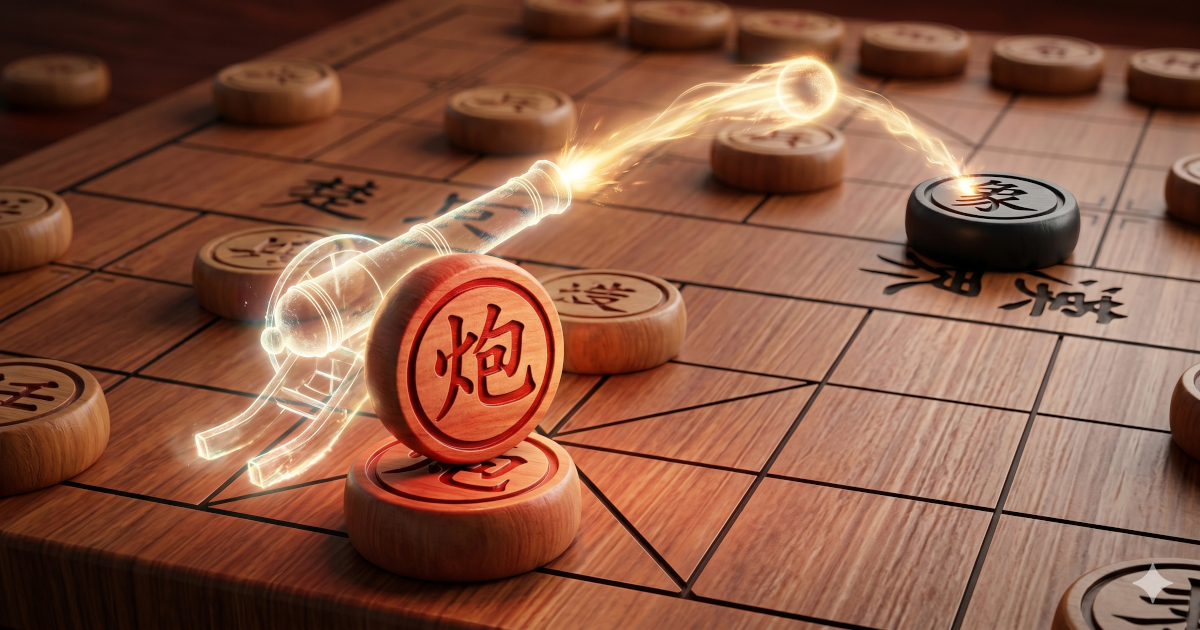
The Cannon: Xiangqi’s Ultimate Sniper Rifle Explained
Table of Contents
- The Unique Mechanics of the Cannon (Pao)
- Opening Dominance: The Era of the Artillery
- The Central Cannon Opening (Dang Tou Pao)
- Mid-Game Mastery: Pins, Skewers, and Psychological Warfare
- The Art of the Pin
- The "Empty Cannon" Threat
- Endgame Dynamics: The Fading Sniper and Synergistic Mates
- The Double Cannon Checkmate
- The Iron Bolt (Chariot and Cannon)
- Actionable Tips to Improve Your Cannon Strategy
- Conclusion
If you are coming to Xiangqi (Chinese Chess) from the world of Western Chess, you will immediately recognize many familiar faces on the board. The Chariot moves exactly like a Rook, the Horse shares the L-shaped hop of a Knight, and the pawns march forward step by step. But right behind the pawn line sits a piece that has absolutely no equivalent in the Western game, a piece that completely redefines the geometry of the board and the pacing of the match. This piece is the Cannon, known in Chinese as the Pao. In the complex, beautiful ecosystem of Xiangqi, the Cannon is the ultimate sniper rifle. It is a piece that thrives on long-range attacks, complex geometry, and psychological pressure. Understanding how the Cannon operates is the first and most critical step to elevating your Xiangqi strategy from beginner to intermediate. In this comprehensive guide, we will break down the mechanics of the Cannon, explore its shifting value across different phases of the game, and explain why mastering this piece is essential for any serious player.
The Unique Mechanics of the Cannon (Pao)
To understand the tactical depth of the Cannon, we first have to understand its movement—and more importantly, its highly unique capturing rules.
- Moving Without Capturing: When the Cannon is simply repositioning itself on the board, it moves exactly like a Chariot (or a Western Rook). It can slide horizontally or vertically across any number of empty intersections.
- The Capture Rule (The Screen): This is where the magic happens. To capture an enemy piece, the Cannon must jump over exactly one piece. This intermediate piece is referred to as the "screen" or the "mount" (pao jia).
The rules regarding the screen are strict but allow for immense creativity:
- The screen can be a friendly piece or an enemy piece.
- The Cannon cannot jump over two or more pieces.
- The Cannon cannot capture a piece without jumping over a screen first.
This single mechanical twist creates a dynamic where pieces are constantly shifting from being safe to being in mortal danger, depending entirely on the movement of the pieces between the Cannon and its target. A piece standing right in front of an enemy Cannon is perfectly safe; a piece standing behind another piece is in the sniper's crosshairs.
Opening Dominance: The Era of the Artillery
Because the Cannon requires a screen to attack, its power scales with the density of the board. Therefore, the Cannon is arguably the most powerful and terrifying piece during the opening phase of a Xiangqi match. At the start of the game, the board is cluttered with pawns, horses, and elephants. Every single piece is a potential screen. This allows Cannons to project force deep into enemy territory before the game has barely begun.
The Central Cannon Opening (Dang Tou Pao)
The most common and aggressive opening in Xiangqi strategy is the Central Cannon (Dang Tou Pao). By moving one of your starting Cannons directly to the center file, you immediately threaten the opponent's central pawn, using your own central pawn as the screen. This forces an immediate response from the opponent, dictating the tempo of the game from move one. If the opponent fails to defend the center properly, the Cannon will blow away the central pawn, creating a devastating early-game check or pinning the opponent's central defenses. The psychological pressure of a Cannon staring directly down the center file at the enemy General cannot be overstated.
Mid-Game Mastery: Pins, Skewers, and Psychological Warfare
As the game transitions into the mid-game, the board opens up slightly, and the Cannon's role shifts from an aggressive battering ram to a piece of surgical precision and control.
The Art of the Pin
The Cannon is the undisputed master of the pin in Xiangqi. By lining up a Cannon with an enemy piece and the enemy General, you freeze the defending piece in place. Because the Cannon requires a screen, the defending piece becomes the very screen that threatens its own General. If the pinned piece moves, the Cannon instantly checks the General. This creates a suffocating tactical environment. A well-placed Cannon can paralyze a Chariot or a Horse, rendering them useless while the rest of your army advances.
The "Empty Cannon" Threat
One of the most dangerous positional advantages you can achieve in the mid-game is the "Empty Cannon" (Kong Tou Pao). This occurs when your Cannon is aimed directly at the enemy General, and there are no pieces between them. While the Cannon cannot currently attack the General (because it lacks a screen), the opponent lives in constant fear that you will simply drop a piece into the gap, creating an instant, lethal check. Defending against an Empty Cannon requires constant vigilance and heavily restricts the opponent's mobility.
Endgame Dynamics: The Fading Sniper and Synergistic Mates
There is a well-known paradox in Xiangqi strategy regarding the Cannon: As the game goes on, the Cannon loses its power. Why? Because as pieces are captured and removed from the board, there are fewer screens available. A Cannon on an empty board is completely useless; it can move, but it cannot capture or threaten anything. Therefore, transitioning into the endgame requires you to pair your remaining Cannons with pieces that can reliably act as screens.
The Double Cannon Checkmate
The most famous and satisfying use of the Cannon in the endgame is the Double Cannon Checkmate (Shuang Pao Jiang). By stacking two Cannons on the same file or rank, the front Cannon acts as the screen, allowing the back Cannon to deliver a lethal check. The front Cannon is protected because the enemy General cannot capture it without exposing itself to the back Cannon. It is a beautiful display of pure synergy.
The Iron Bolt (Chariot and Cannon)
Another devastating endgame pattern is the Chariot-Cannon synergy. The Chariot acts as an indestructible screen for the Cannon. Because the Chariot is so powerful at close range, the enemy General cannot approach it, allowing the Cannon resting behind the Chariot to deliver unblockable checks from a distance.
Actionable Tips to Improve Your Cannon Strategy
If you want to harness the full power of Xiangqi's ultimate sniper rifle, keep these high-level strategic principles in mind during your next matches:
- Do Not Trade Cannons for Horses Too Early: While Cannons and Horses are roughly equal in value (often worth about 4 to 4.5 points), Cannons are vastly superior in the opening. Try to preserve your Cannons during the early skirmishes to maintain long-range pressure.
- Use the Opponent’s Pieces Against Them: The most frustrating screens for an opponent are their own pieces. Pinning an enemy Chariot against their General using their own Advisor as a screen is a massive tactical victory.
- Prepare for the Endgame Transition: Always be aware of the piece count. If the board is simplifying and you have Cannons remaining, you must preserve your pawns or Advisors to act as screens in the final moments of the game. An unsupported Cannon is a dead piece.
- Control the Open Files: Just like Rooks in Western Chess, Cannons need open lanes to operate effectively. Clear out pawns to create long vertical and horizontal lines of sight for your artillery.
Conclusion
The Cannon is the heart and soul of Xiangqi's unique tactical identity. It is a piece that demands foresight, geometric awareness, and a deep understanding of board dynamics. It can be a blunt instrument in the opening, a paralyzing control piece in the mid-game, and a synergistic finisher in the endgame. Mastering the Cannon means learning to look past the immediate squares around your pieces and viewing the board as a grid of intersecting firing lanes. Once you learn to harness the power of the screen and set up those perfect, cross-board sniper shots, you will unlock a level of satisfaction that only Xiangqi can provide. Set up the board, place your artillery, and let the games begin.
Comments (0)
You need to log in to join the discussion.
No comments yet. Be the first to share your thoughts!