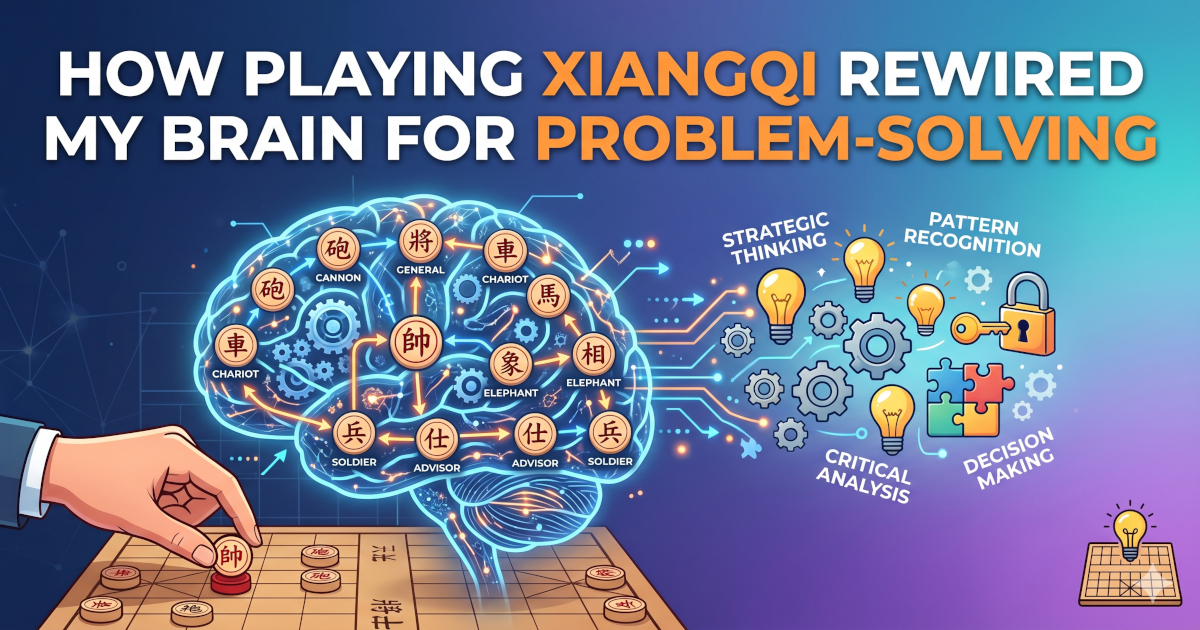
How Playing Xiangqi Rewired My Brain for Problem-Solving
Table of Contents
- 1. Embracing Chaos: The End of "Analysis Paralysis"
- 2. Lateral Thinking: The Genius of the Cannon
- 3. Agile Problem-Solving: Managing the Hobbled Horse
- 4. Delegated Leadership: The Power of the Flying General
- 5. Ruthless Decisiveness: The Eradication of the Draw
- The Verdict: Upgrade Your Mental Software
If you want to get better at solving complex problems, the standard advice is usually the same: read more books, learn to code, or start playing chess. For years, I followed that advice. I studied Western chess, memorized openings, and learned how to slowly grind down an opponent by controlling the center of the board. It was a fantastic mental workout, but eventually, my problem-solving felt rigid. I was thinking in straight lines and slow, methodical progressions. Then, I discovered Xiangqi (widely known as Chinese Chess), and it felt like someone took my cognitive framework, flipped it upside down, and set it on fire. Boasting an estimated 500 million players worldwide, Xiangqi is a blazing fast, hyper-aggressive simulation of ancient warfare. But beyond its historical roots, Xiangqi is an unparalleled engine for neuroplasticity. Playing this game didn't just give me a new hobby; it fundamentally rewired the way I process information, manage crises, and approach real-world problem-solving. If you are feeling stuck in your career, struggling with complex projects, or just experiencing brain fog, here is how stepping onto the Xiangqi board can upgrade your mind.
1. Embracing Chaos: The End of "Analysis Paralysis"
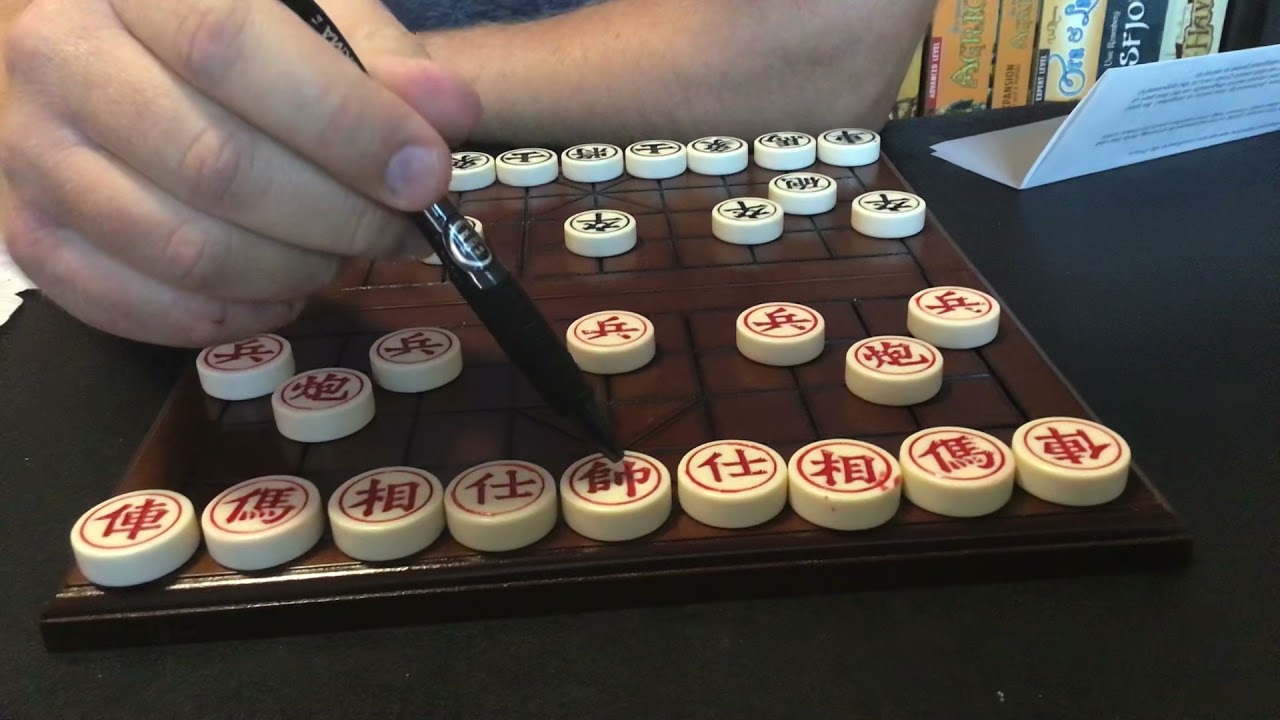
In Western chess, the game starts with a literal wall of pawns. You spend the first ten moves carefully developing your pieces behind this barricade. It teaches patience, but it also allows for procrastination. You can delay the real conflict while you set up the "perfect" position. Xiangqi does not give you that luxury. The pawns (Soldiers) are spaced out, meaning the board is wide open from Move 1. Devastating pieces like the Chariot (Rook) and the Cannon can immediately infiltrate your camp. The threat level is at maximum from the very first second. The Real-World Translation: Before Xiangqi, my default response to a sudden crisis at work was analysis paralysis. I wanted to build a "pawn wall"—to gather more data, delay the decision, and hide behind preparation. Xiangqi rewired my brain to accept that chaos is the default state. You cannot wait for the perfect moment to engage with a problem because the problem is already in your base. It trained me to process high-stress information rapidly and make decisive moves even when I don't feel 100% prepared.
2. Lateral Thinking: The Genius of the Cannon
If you want to train your brain to think outside the box, no tool on earth is better than the Xiangqi Cannon (Pao). The Cannon moves in straight lines, but to capture an enemy piece, it must jump over exactly one intermediate piece (called the screen). Without a screen, the Cannon is harmless. With a screen, it is a lethal sniper. This single mechanic forced me to completely change how I view spatial geometry and resources. You are constantly looking for unconventional angles. You might look at your opponent’s defensive Elephant not as an obstacle, but as a launchpad for your own Cannon to strike their General. The Real-World Translation: This is the ultimate exercise in lateral thinking. In business and life, we often look at obstacles—a tight budget, a strict regulation, a stubborn competitor—as things that block our path. The Cannon rewired my brain to ask: "How can I use this obstacle as a screen? How can I leverage this constraint to launch my own initiative?" I stopped looking for empty lanes and started looking for ways to use the existing clutter to my advantage.
3. Agile Problem-Solving: Managing the Hobbled Horse
In regular chess, the Knight is a magical piece that can jump over any obstacle. It doesn't care about the pieces around it; it just phases through them. In Chinese Chess, the Horse (Ma) moves in a similar L-shape, but it cannot jump over pieces. If there is a piece sitting directly next to the Horse, its leg is "hobbled," and it is completely blocked from moving in that direction. Because the board is constantly shifting, a Horse that is a dominant attacking piece on one turn can become completely paralyzed the next, simply because a pawn stepped in front of its knee. The Real-World Translation: This mechanic is a masterclass in dynamic resource management. Real-world solutions rarely operate in a vacuum (like the Western Knight). In reality, our resources are easily "hobbled" by shifting market conditions, sudden staffing shortages, or supply chain issues. Xiangqi trained me to stop relying on rigid, long-term plans. Instead, my brain learned to operate in an agile framework, constantly pivoting and reassessing the utility of my tools based on the immediate environment.
4. Delegated Leadership: The Power of the Flying General
One of the most profound rule differences in Chinese Chess involves the General (the King). The General is permanently trapped in a 3x3 grid called the Palace. However, thanks to the "Flying General" rule, the two opposing Generals can never face each other on an open column. If they do, the game is instantly over. This means the General, despite being confined to a bunker, exerts an invisible, laser-like pressure across the entire board. It can pin enemy pieces and assist in checkmates without ever leaving its base. The Real-World Translation: For anyone in management or leadership, this is a profound lesson in problem-solving through delegation and positioning. I used to think that solving a problem meant I had to jump onto the front lines and micromanage every detail (like a King marching up the board in a chess endgame). Xiangqi taught me the power of the Flying General: you can exert massive influence and solve problems by simply holding the right position, securing your core, and letting your frontline units (your team) do the heavy lifting. True power doesn't always require physical movement.
5. Ruthless Decisiveness: The Eradication of the Draw
One of the most frustrating aspects of Western chess is the stalemate. If a player is not in check but has no legal moves left, the game is a draw. You can thoroughly outplay someone, but if you make a slight miscalculation at the end, they escape with a tie. Xiangqi does not reward suffocation with a draw. If you have no legal moves left, you lose. Furthermore, you are legally forbidden from putting your opponent in perpetual check just to force a draw. The Real-World Translation: Xiangqi demands a definitive conclusion. It rewired my brain to stop looking for the "easy way out" of a complex problem. In life, we often try to force a stalemate—we avoid having the hard conversation, we sit on a mediocre investment, or we endlessly delay a product launch because we are afraid of failing. Xiangqi forces you to push for a decisive win or accept a decisive loss. It cures the habit of fence-sitting.
The Verdict: Upgrade Your Mental Software
Neuroplasticity—the brain's ability to reorganize itself by forming new neural connections—thrives on novelty and complex problem-solving. If you have been playing the same mental games for years, your brain has likely plateaued. Picking up Xiangqi was the ultimate shock to my cognitive system. It took the tactical foresight I learned from Western chess and injected it with adrenaline, lateral geometry, and ruthless efficiency. It taught me how to find the hidden launchpads in my obstacles, how to act decisively in chaotic environments, and how to stay agile when my plans get hobbled. If you are looking for a way to rewire your brain, sharpen your focus, and master the art of dynamic problem-solving, step away from the 64 squares. Buy a wooden Xiangqi set, memorize the characters, and cross the Chu River. Your brain will thank you for it.
Comments (0)
You need to log in to join the discussion.
No comments yet. Be the first to share your thoughts!