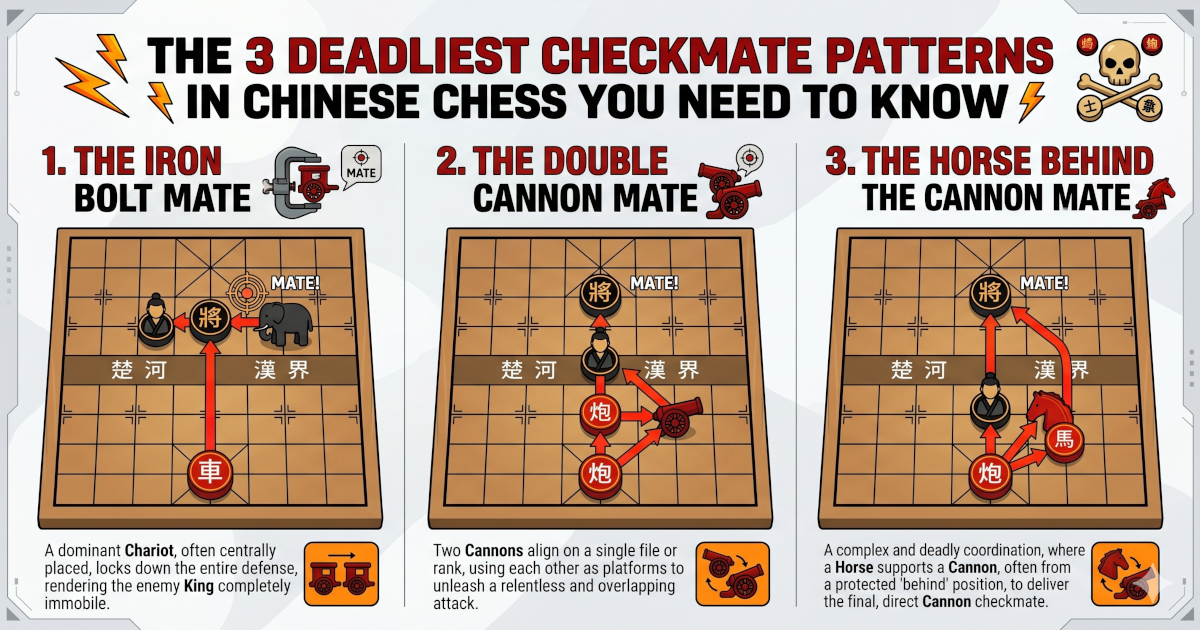
The 3 Deadliest Checkmate Patterns in Chinese Chess You Need to Know
Table of Contents
- The Foundation: Understanding the Palace and the Flying General
- 1. The Iron Bolt (Tie Men Shuan)
- The Setup
- How the Trap Springs
- Pro Tip for Execution
- 2. The Double Cannon Mate (Liang Pao Jiang)
- The Setup
- How the Trap Springs
- Pro Tip for Execution
- 3. The Horse Behind the Cannon (Ma Hou Pao)
- The Setup
- How the Trap Springs
- Pro Tip for Execution
- Quick Reference Summary
- Conclusion: Sharpening Your Tactical Vision
If you are stepping into the world of Xiangqi (Chinese Chess), you must quickly abandon the slow, methodical endgame grinds you might be used to in Western chess. Xiangqi is a game of rapid strikes, explosive tactics, and ruthless aggression. Because the board is wide open from the very first move and heavy artillery like the Cannon can strike from across the river, games frequently end in sudden, inescapable checkmates. To dominate the board and climb the ranks, you cannot simply rely on reacting to your opponent. You must actively hunt for mating nets. In Chinese Chess, tactical checkmates are built around specific, repeating geometric patterns. Once you learn to recognize these shapes, you will start seeing winning opportunities hidden in the chaos of the mid-game. Whether you are a beginner looking to understand the mechanics or an intermediate player wanting to sharpen your offensive edge, mastering these formations is non-negotiable. Here is a deep dive into the 3 deadliest checkmate patterns in Chinese Chess, how they work, and how you can unleash them on your opponents.
The Foundation: Understanding the Palace and the Flying General
Before we break down the specific checkmates, we must establish the two golden rules of Xiangqi that make these lethal patterns possible. If you do not understand these, the checkmates will not make sense:
- The Palace Constraint: The General (the equivalent of the King) and the Advisors are permanently confined to a 3x3 grid at the back of the board called the Palace. They can never leave this bunker.
- The Flying General Rule: The two opposing Generals can never face each other on the same open file (vertical column) without any pieces sitting between them. If your General is on an open file, the enemy General cannot step onto that same file. The General essentially acts as a long-range sniper that controls entire columns.
Because the enemy General is trapped in a 3x3 box, you do not need to chase it around the board. You just need to lock the doors to the Palace. Here are the three most devastating ways to do exactly that.
1. The Iron Bolt (Tie Men Shuan)
The Iron Bolt is arguably the most famous and psychologically crushing checkmate in all of Xiangqi. It perfectly demonstrates how a few pieces can completely paralyze an opponent’s defense.
The Setup
This checkmate relies on absolute control of the center file. It typically involves two of your most powerful pieces: a Cannon (Pao) and a Chariot (Ju).
- Your Cannon is positioned directly on the center file, aiming straight down at the enemy General.
- Your Cannon is using an enemy piece (usually an Elephant or Advisor) or one of your own pieces as a "screen" to threaten the General.
How the Trap Springs
Once your Central Cannon has locked the enemy General into the center file, the enemy General cannot move left or right. The doors are bolted shut. Next, you maneuver your Chariot straight down into the enemy Palace, placing it right next to the enemy General. In Western chess, placing a piece directly next to the King without protection would just result in the King capturing it. But in Xiangqi, the Flying General rule comes into play. Because your Central Cannon is backing up your Chariot, the enemy General cannot capture the Chariot—doing so would mean putting themselves in check from your Cannon. The Iron Bolt snaps shut, and the game is instantly over.
Pro Tip for Execution
Look for opportunities to execute the Iron Bolt when your opponent aggressively moves their defensive pieces (Elephants and Advisors) to the flanks, leaving the center file weakly defended. Establish your Central Cannon early and hold that position at all costs.
2. The Double Cannon Mate (Liang Pao Jiang)
The Cannon is Xiangqi’s most unique and fascinating piece because it requires a "screen" (another piece to jump over) in order to capture. The Double Cannon Mate weaponizes this jumping mechanic in a way that feels like an inescapable firing squad.
The Setup
As the name suggests, this checkmate requires you to line up both of your Cannons on the exact same file (column) or rank (horizontal row) aiming directly at the enemy General.
How the Trap Springs
When two Cannons are stacked in the same line, they create a terrifying synergy.
- The front Cannon acts as the direct threat, but more importantly, it acts as the screen for the back Cannon.
- Because the back Cannon uses the front Cannon to jump over, the enemy General is placed in check.
If the enemy General tries to capture the front Cannon to escape, they are instantly stepping into the crosshairs of the back Cannon. It is a lethal paradox. Even if the opponent tries to place a blocking piece in front of the two Cannons, it rarely helps, as the Cannons can simply jump over the new block or rearrange their screens.
Pro Tip for Execution
The Double Cannon Mate is exceptionally deadly in the endgame when the board is relatively empty of pawns. It is most commonly executed along the back rank (horizontal row) inside the enemy Palace or straight down the central file. Always keep your Cannons paired together in the endgame; they are exponentially more dangerous as a duo than as solo operatives.
3. The Horse Behind the Cannon (Ma Hou Pao)
While the Chariot represents brute force and the Cannon represents long-range artillery, the Horse (Ma) represents tricky, angled agility. When you combine the Horse with the Cannon, you create the Ma Hou Pao—a smothering, highly tactical checkmate pattern that is incredibly difficult to defend against.
The Setup
This pattern uses the Horse to cut off the escape routes of the enemy General, while the Cannon delivers the fatal blow from behind the Horse.
- You place your Horse in a position where it attacks the enemy Palace, typically sitting just outside the Palace walls, aiming at the General's escape squares.
- You then slide your Cannon directly behind your Horse on the same line as the enemy General.
How the Trap Springs
The beauty of the Ma Hou Pao is its flawless synergy. Your Horse does two jobs simultaneously:
- It controls the diagonal squares, preventing the enemy General from stepping out of the line of fire.
- It acts as the perfect, immovable screen for your Cannon.
Because the Cannon is jumping over your own Horse to check the General, the opponent is trapped. They cannot move out of the way because the Horse is guarding the exits, and they cannot capture the Cannon because it is safely tucked behind the Horse. It is a suffocating, angled ambush.
Pro Tip for Execution
The key to setting up the Ma Hou Pao is managing the "hobbling" mechanic of the Xiangqi Horse. Remember that the Horse cannot jump over adjacent pieces. You must carefully clear the path for your Horse to reach the perimeter of the enemy Palace without getting its legs blocked. Once the Horse is anchored, slide the Cannon in for the execution.
Quick Reference Summary
To help you memorize these deadly configurations, here is a quick breakdown of the three patterns:
| Checkmate Pattern | Key Pieces Required | Core Mechanism | Best Time to Use |
|---|---|---|---|
| The Iron Bolt | Cannon + Chariot | Center file lockdown; General cannot capture the attacking Chariot. | Mid-game, when the opponent's center is weak. |
| Double Cannon | Cannon + Cannon | The front Cannon acts as an inescapable screen for the back Cannon. | Endgame, especially along the back rank. |
| Ma Hou Pao | Horse + Cannon | The Horse blocks escape routes and acts as a screen for the Cannon. | Late Mid-game, exploiting cluttered Palace defenses. |
Conclusion: Sharpening Your Tactical Vision
Winning at Chinese Chess is not just about capturing the most pieces; it is about recognizing geometric patterns and executing them flawlessly. The Iron Bolt, the Double Cannon, and the Horse Behind the Cannon are the holy trinity of Xiangqi checkmates. The next time you sit down to play, stop simply reacting to what your opponent is doing. Take control of the board. Command the central file, pair your Cannons together, and look for angles to sneak your Horse to the edge of the Palace. Once you train your brain to spot these three deadly checkmate patterns, you will stop just playing the game—you will start ending it.
Comments (0)
You need to log in to join the discussion.
No comments yet. Be the first to share your thoughts!