The Bizarre Story Behind the "Elephants" in Chinese Chess
Table of Contents
- The "Elephant Game": Decoding the Name Xiangqi
- 1. The Indian Connection (Chaturanga)
- 2. The "Image" Game
- The Bizarre Rules of the Xiangqi Elephant
- The Pacifist Defender: Banned from the Frontlines
- The "Eye of the Elephant"
- The Ultimate Identity Crisis: Elephant vs. Minister
- From Eastern Elephants to Western Bishops
- Conclusion: Mastering the Beasts of Defense
If you sit down to play a game of Western chess, the pieces staring back at you make logical sense for a medieval European battlefield. You have the foot soldiers (Pawns), the cavalry (Knights), the siege towers or castles (Rooks), the religious advisors (Bishops), and the ruling monarchs (King and Queen). But if you turn your attention to Xiangqi, globally known as Chinese Chess, the roster of pieces gets a little more eccentric. Alongside Chariots, Cannons, and Horses, you will find a piece that often perplexes Western players: The Elephant. At first glance, the inclusion of an Elephant seems straightforward. Ancient armies used war elephants, right? But the deeper you dig into the mechanics, history, and linguistic quirks of the Elephant in Chinese Chess, the weirder the story gets. Why is a massive, trampling beast of war forbidden from ever crossing the middle of the board? Why does the piece magically change its identity from an animal to a government bureaucrat depending on which color you play? And perhaps most bizarrely of all, why is the entire game of Chinese Chess literally named after this one specific piece? Let’s unpack the fascinating, slightly bizarre story behind the Elephants in Xiangqi.
The "Elephant Game": Decoding the Name Xiangqi
To understand the Elephant's role, we have to start with the name of the game itself. In Chinese, the game is called 象棋 (Xiangqi).
- Qi (棋): Translates to "board game" or "chess."
- Xiang (象): Translates directly to "Elephant."
Yes, the literal translation of Xiangqi is the "Elephant Game." This presents an immediate historical puzzle. The board of Xiangqi represents the Chu-Han Contention (206–202 BC), a civil war fought in the central plains of China. While war elephants were used in ancient China—specifically during the much older Shang Dynasty and in the southern, tropical regions—they were absolutely not the primary engines of war during the Chu-Han conflict. That era was dominated by cavalry, chariots, and mass infantry. So why name the most popular board game in Chinese history after an animal that rarely saw the battlefield in that specific war? Historians point to two main theories:
1. The Indian Connection (Chaturanga)
All forms of chess—whether Western, Chinese, or Japanese (Shogi)—are widely believed to trace their roots back to a 6th-century Indian game called Chaturanga. In Chaturanga, the army featured four divisions: infantry, cavalry, chariots, and war elephants (called Gaja). As Chaturanga traveled eastward into China via the Silk Road, the game evolved to fit Chinese culture and military history. However, the legacy of the Indian war elephant was so strong that the piece survived the cultural translation, and the game itself may have been dubbed the "Elephant Game" as a nod to its exotic origins.
2. The "Image" Game
Chinese characters are famously multi-layered. The character 象 (Xiang) originally meant "elephant," but over centuries, it evolved to also mean "image," "figure," "representation," or "phenomenon" (such as constellations in the sky). Many scholars argue that Xiangqi should actually be translated as the "Figure Game" or "Simulation Game," reflecting the fact that the carved wooden pieces are symbolic representations of a real army. The literal animal meaning just happened to stick to the specific defensive piece.
The Bizarre Rules of the Xiangqi Elephant
If you assume a piece called the "Elephant" operates like a heavy, destructive tank, the rules of Xiangqi will quickly humble you. The Elephant is arguably the most restricted piece on the board, governed by a set of highly specific, almost pacifist rules.
The Pacifist Defender: Banned from the Frontlines
In Xiangqi, the board is divided in half by a blank space called the River. The most defining rule of the Elephant is that it can never cross the River. Despite being a massive beast of war, the Elephant in Chinese Chess is a strictly defensive piece. It is legally bound to its own half of the board. Its sole purpose is to patrol the homeland, build defensive formations, and shield the General from enemy attacks. Historically, this makes a strange kind of sense. War elephants were incredibly heavy and difficult to transport. Attempting to march a battalion of elephants across a rushing river in the middle of a battle would be a logistical nightmare. In the game, they are relegated to homeland security.
The "Eye of the Elephant"
The movement of the Elephant is equally quirky. It moves exactly two intersections diagonally. However, unlike the Knight in Western chess, the Elephant cannot jump over other pieces. If there is a piece (friend or foe) sitting on the intersection directly in the middle of the Elephant's 2x2 diagonal path, the Elephant is blocked. In Xiangqi terminology, this blocking spot is called the "Eye of the Elephant." If the eye is filled, the Elephant cannot move in that direction. This mechanic forces players to carefully manage their defensive formations. A poorly placed friendly pawn can blind your own Elephant, collapsing your entire defensive structure just when the enemy Cannon fires.
The Ultimate Identity Crisis: Elephant vs. Minister
If you thought the river restrictions were strange, the Elephant's identity crisis will truly confuse new players. In Xiangqi, the two sides are typically Red and Black. While the pieces on both sides possess the exact same powers and movements, they often feature different Chinese characters to distinguish between the two armies.
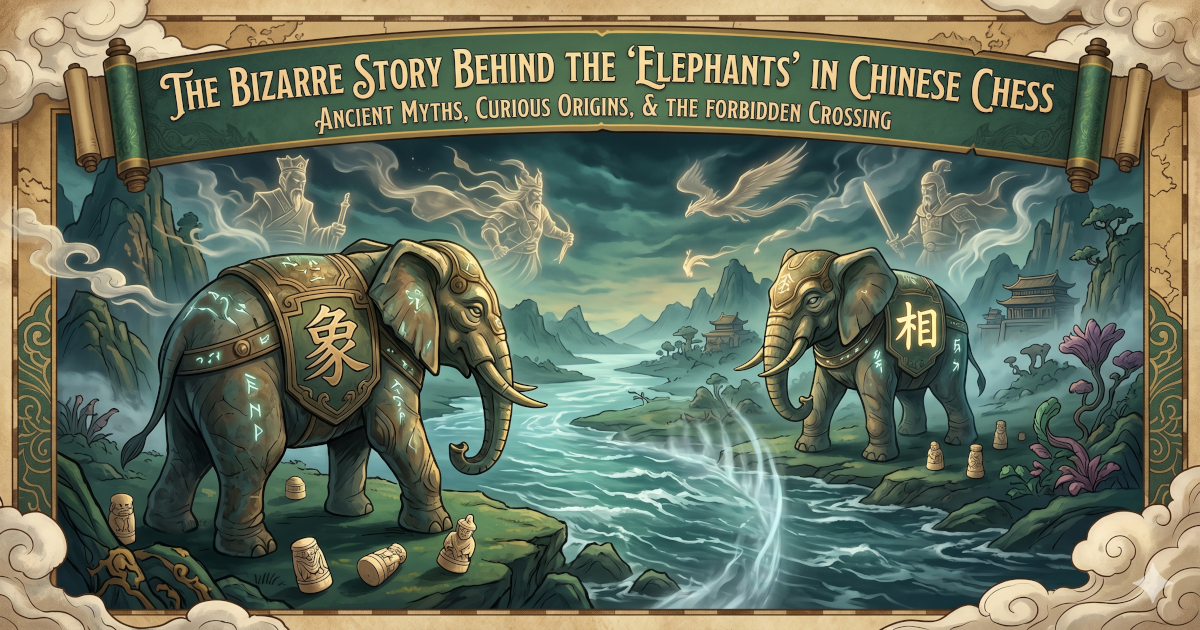
- On the Black side, the piece is carved with the character 象 (Xiang), meaning Elephant.
- On the Red side, the piece is carved with the character 相 (Xiang), meaning Minister or Premier.
They are pronounced exactly the same way, but their meanings are worlds apart. Why does the Black army get a towering jungle beast, while the Red army gets a scholarly government bureaucrat in a silk robe? This duality ties back to the lore of the Chu-Han Contention.
- The Black Side generally represents Xiang Yu, the Hegemon-King of Chu. He was a fierce, terrifying, and physically dominant warlord from the south, making the untamed Elephant a fitting symbol for his defensive lines.
- The Red Side represents Liu Bang, the King of Han. Liu Bang was less of a warrior and more of a cunning politician who relied heavily on brilliant statesmen and bureaucratic advisors. Thus, his defensive pieces are represented by the Minister.
Despite the name change, the Red Minister still follows all the rules of the Black Elephant—including being blocked by the "Eye of the Elephant" (which, humorously, means the Minister is blocked if someone stands in the "Eye of the Minister").
From Eastern Elephants to Western Bishops
To truly appreciate the bizarre journey of the Xiangqi Elephant, you have to look at its distant cousin in Western chess: The Bishop. When Chaturanga migrated West into the Islamic world, the Indian Gaja (Elephant) was called the Alfil (Arabic for "the elephant"). However, Islamic art strictly forbade the realistic depiction of animals or humans. As a result, the Alfil piece was abstracted into a simple block of wood with two small bumps on top, meant to represent the two tusks or the ears of an elephant. When the game eventually reached medieval Europe, the Europeans had no idea what an elephant was. They looked at the piece with the two bumps on top and thought, "That looks exactly like a Catholic Bishop's mitre (the pointy hat)!" Thus, the Elephant was forever transformed into the Bishop in the West. It gained the ability to sweep across the entire board, becoming an offensive powerhouse. Meanwhile, in the East, the Elephant remained true to its name. It stayed heavy, it stayed defensive, and it stayed firmly planted behind the River.
Conclusion: Mastering the Beasts of Defense
The next time you play a game of Chinese Chess, take a moment to appreciate the Elephants (and the Ministers). They may not be the flashiest pieces on the board. They cannot charge across the river like the Pawns, and they cannot strike from the shadows like the Cannons. But these bizarre, river-bound defenders are the glue that holds a Xiangqi army together. Mastering their interlocking, diagonal patrols is the key to surviving the rapid-fire aggression of Chinese Chess. They are a beautiful reminder of the game's ancient roots, bridging the gap between Indian war beasts, Chinese linguistic puns, and the historical reality of the Chu-Han war.
Comments (0)
You need to log in to join the discussion.
No comments yet. Be the first to share your thoughts!