The "Flying General" Rule That Makes Chinese Chess Terrifying
Table of Contents
If you are a seasoned player of Western chess, you know exactly how the King operates. For the first twenty moves of the game, he is a fragile coward, desperately hiding behind a wall of pawns after castling. But as the board clears and the endgame approaches, the King transforms. He marches out into the open, escorting his surviving pawns to promotion and actively participating in the final battle. Now, imagine a game where the King is permanently locked in a 3x3 bunker. He can never leave. He can never march across the board. Yet, despite being trapped, he possesses a terrifying, invisible superpower that spans the entire length of the battlefield—a power that can paralyze enemy troops, execute sudden checkmates, and strike fear into the opponent from across the board. Welcome to the world of Xiangqi (Chinese Chess), and the most ruthless mechanic in abstract strategy gaming: The Flying General Rule. If you are transitioning from Western chess to Chinese chess, this single rule will completely rewire your brain. Here is a deep dive into what the Flying General rule is, the bloody history that inspired it, and why it makes Xiangqi an absolutely terrifying game to play.
What is the Flying General Rule?
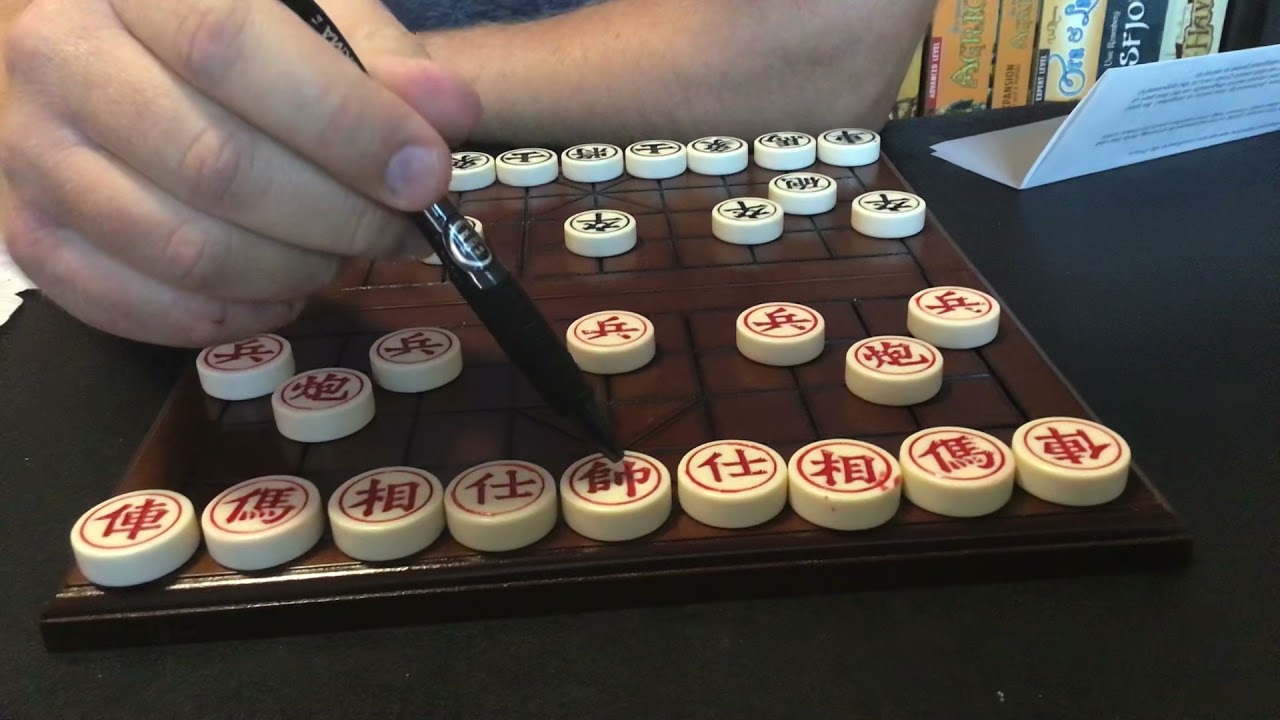
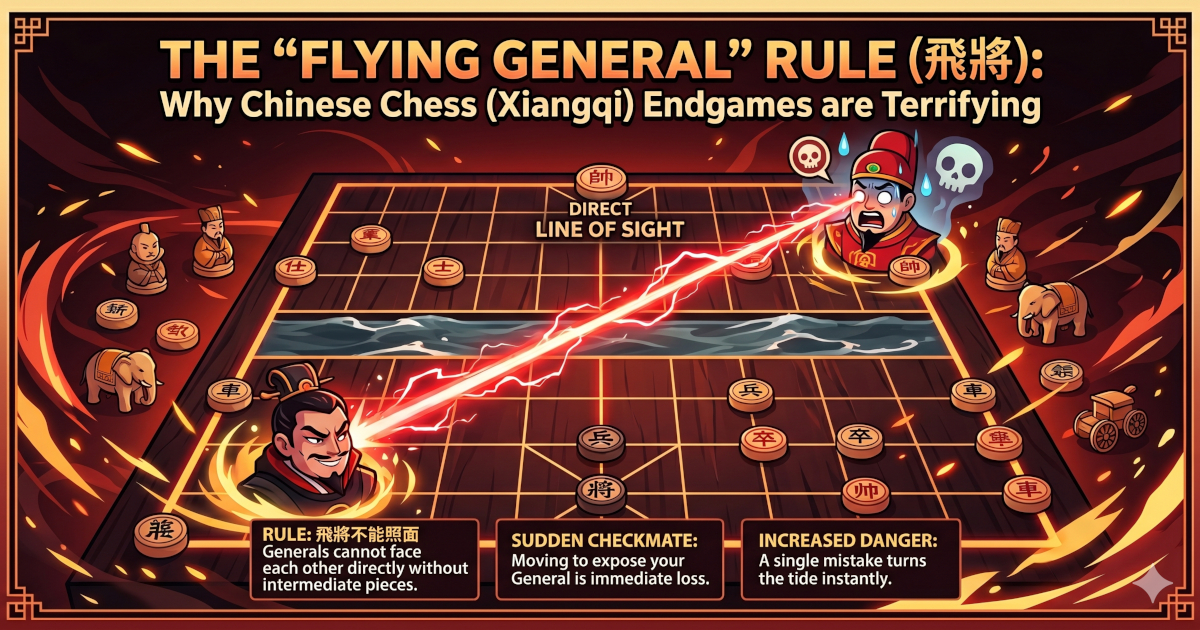
To understand the terror, you must first understand the battlefield. In Xiangqi, the equivalent of the King is the General (Shuai for Red, Jiang for Black). At the back of each player's side of the board sits a 3x3 square marked with diagonal lines known as the Palace. The General, along with his two defensive Advisors, is strictly forbidden from ever stepping outside this Palace. Because the General cannot leave the Palace, you might assume he is purely a defensive piece, waiting passively to be attacked. But the creators of Xiangqi gave the General a lethal quirk: The two opposing Generals can never face each other on an open file (vertical column) without any pieces between them.
- The Invisible Laser: If your General is sitting on a specific column, and there are no pieces (friend or foe) between him and the enemy General, your opponent cannot move their General onto that same column.
- The Illegal Reveal: If there is a single piece sitting between the two Generals, neither player is allowed to move that piece out of the way. Doing so would leave the Generals staring at each other face-to-face, which is an illegal move (akin to putting your own King in check).
- The "Flight": If your opponent accidentally exposes their General on an open file, you can "fly" your General across the board to capture them, ending the game instantly.
Because of this rule, the General acts like a massive, invisible sniper rifle. Merely by existing inside his bunker, he projects a lethal line of sight across the entire board.
The Dark History: Why the Rule Exists
Why would ancient game designers create a piece that cannot move past its own backyard but can exert power across the entire board? The answer lies in the blood-soaked history of the Chu-Han Contention (206–202 BC), the civil war that Xiangqi simulates. During this war, the two opposing warlords—the towering, fearsome Xiang Yu (Chu) and the cunning, pragmatic Liu Bang (Han)—found themselves at a grueling stalemate. Their massive armies were camped on opposite sides of the Guangwu Gorge, separated by a deep, rushing canal. According to historical records, Xiang Yu grew frustrated with the stalemate. He stepped out into the open, looked across the gorge, and shouted a challenge to Liu Bang, demanding they settle the war in single combat. Liu Bang, knowing he would be slaughtered in a physical fight, instead rode to the edge of the ravine and began shouting a list of Xiang Yu’s crimes, publicly humiliating him. But Xiang Yu had set a trap. While Liu Bang was monologuing, a master crossbowman hidden in the Chu encampment took aim. A heavy crossbow bolt flew across the ravine, striking Liu Bang square in the chest and nearly killing him. The Flying General rule immortalizes this exact moment of treachery and tactical genius. The rule dictates that a supreme commander must never stand in the open, face-to-face with the enemy commander. If they do, the hidden sniper's bolt will strike them down.
Why the Flying General Makes Xiangqi Terrifying
Understanding the history is fascinating, but experiencing the rule on the board is a masterclass in psychological tension. Here is why the Flying General rule turns Xiangqi into a cutthroat, terrifying experience.
1. The "Face-to-Face" Checkmate
In Western chess, a King can never directly checkmate the opposing King. They repel each other like magnets. In Xiangqi, the General is frequently the primary supporting piece in a checkmate. The most common iteration of this is the Iron Bolt checkmate. If you use your General to control the center file, your opponent’s General cannot step onto that file. You can then drive a Chariot (Rook) straight down the board, right into the enemy General's face. Because your General is providing "cover fire" from across the board, the enemy General is forbidden from capturing your Chariot. Your trapped General just orchestrated an execution without moving an inch.
2. Absolute Paralysis (The Phantom Pin)
There are few feelings worse in board gaming than the "Phantom Pin." Imagine you have a powerful Chariot positioned perfectly in the center of the board, ready to launch an attack. But your General and the enemy General are on the same column, and your Chariot is the only piece sitting between them. Suddenly, your most powerful piece is paralyzed. You cannot move your Chariot, because doing so would expose your General to the enemy's line of sight. Your opponent didn't even have to attack your Chariot to neutralize it; they simply used the geography of the board and the stare of their General to completely shut down your offense.
3. The Sudden, Accidental Suicide
For players new to Xiangqi, the Flying General is the ultimate booby trap. Because the board is larger (9x10 intersections) and pieces move at blinding speeds, it is incredibly easy to lose track of the invisible lines of sight. You might proudly execute a brilliant tactical combination, moving your final defensive piece out of the way to launch a counter-attack, only to realize you just exposed your own General to the enemy commander across the board. The game abruptly ends. You didn't get checkmated; you accidentally stepped into the sniper's crosshairs.
King vs. General: A Strategic Breakdown
To summarize how this mechanic completely alters the game, here is a quick comparison between the supreme pieces of Western and Chinese Chess:
| Feature | Western Chess (King) | Xiangqi (General) |
|---|---|---|
| Mobility | Can move anywhere on the board (1 square at a time). | Strictly confined to a 3x3 Palace. |
| Endgame Role | Becomes an active, frontline attacker. | Remains in the bunker; acts as a long-range sniper. |
| Piece Interaction | Cannot stand next to the enemy King. | Cannot face the enemy General on an open vertical file. |
| Checkmating Power | Cannot directly assist in delivering a checkmate. | Frequently used to pin pieces and support checkmating attackers. |
Embrace the Sniper's Gaze
Xiangqi is a game that rewards hyper-aggression, rapid development, and spatial awareness. While the Cannons and Chariots get all the glory for their explosive movements, the true silent killer of the board is the General. The Flying General rule elevates Xiangqi from a simple game of moving pieces to a tense, psychological standoff. It forces you to constantly scan the board for invisible sightlines, turning every open column into a potential death trap. If you are looking for a board game that will push your lateral thinking to its absolute limits, set up a Xiangqi board. But be warned: when you clear the center file, make sure you know exactly who is staring back at you from across the Chu River. One wrong step, and the Flying General will strike.
Comments (0)
You need to log in to join the discussion.
No comments yet. Be the first to share your thoughts!