Why the Two Generals Can Never Meet: The Dark Secret Hidden in Xiangqi
Table of Contents
- The "Flying General" Rule Explained
- The Board is a Real Battlefield
- The Dark Secret: The Sniper at Guangwu Gorge
- The Birth of the Rule
- How the Rule Changes Xiangqi Strategy
- 1. The General as an Attacking Weapon
- 2. The "Face-to-Face Laugh" Checkmate
- 3. The Ultimate Defensive Shield
- Conclusion: A Game Steeped in History
If you are familiar with Western chess, you know that the King is a fragile monarch. He hides behind a wall of pawns, shuffles out of the way of danger, and generally avoids the front lines until the endgame. While two opposing Kings can never stand squarely next to each other on the 64-square board, there is no rule preventing them from staring each other down from across the board on an open file. But in Xiangqi (Chinese Chess), the rules of royal engagement are drastically, almost violently, different. In Xiangqi, the equivalent of the King is the General (often marked as Shuai for the red side and Jiang for the black side). These Generals are permanently confined to a 3x3 fortress known as the "Palace." They can never leave this bunker. Yet, despite being trapped, the General possesses a terrifying, invisible power that spans the entire length of the board: The two Generals are forbidden from ever facing each other on the same open column without any pieces sitting between them. This unique mechanic is known to players as the Flying General rule. On the surface, it is a brilliant tactical quirk that makes Xiangqi endgames thrilling. But beneath the polished wooden pieces and the grid of the board lies a dark, bloody secret from ancient Chinese history. Here is the true story of why the two Generals can never meet, and how a 2,000-year-old assassination attempt forever changed the greatest board game in Asia.
The "Flying General" Rule Explained
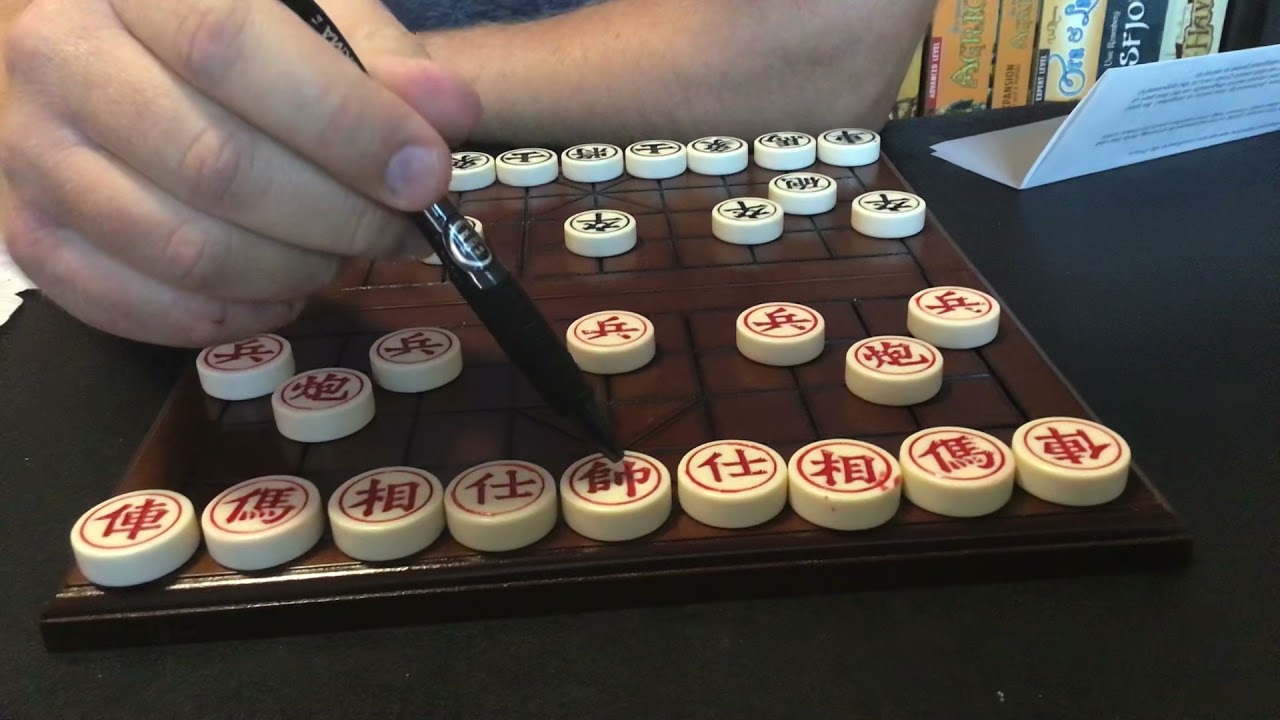
Before diving into the history, it is crucial to understand exactly how this rule functions on the board. For new players transitioning from Western chess to Chinese chess, the Flying General rule is often the hardest habit to learn—and the easiest way to accidentally lose a game.
- The Law of the Open File: If the Red General and the Black General are on the same vertical line (file), there must be at least one piece (friend or foe) between them.
- The Invisible Laser Beam: If you move a piece out of the way, leaving the two Generals staring directly at each other with nothing in between, that move is strictly illegal. It is the equivalent of moving your own king into check.
- The "Flying" Strike: If your opponent’s General is exposed on a file, and you move your General onto that same file to face them, it is said that your General "flies" across the board to capture the enemy commander.
Because of this rule, the General is not just a passive piece waiting to be checkmated. It is an active, long-range sniper rifle. But why would a board game design a piece that cannot leave its bunker, yet can project lethal force across a river? To answer that, we have to look at the board itself.
The Board is a Real Battlefield
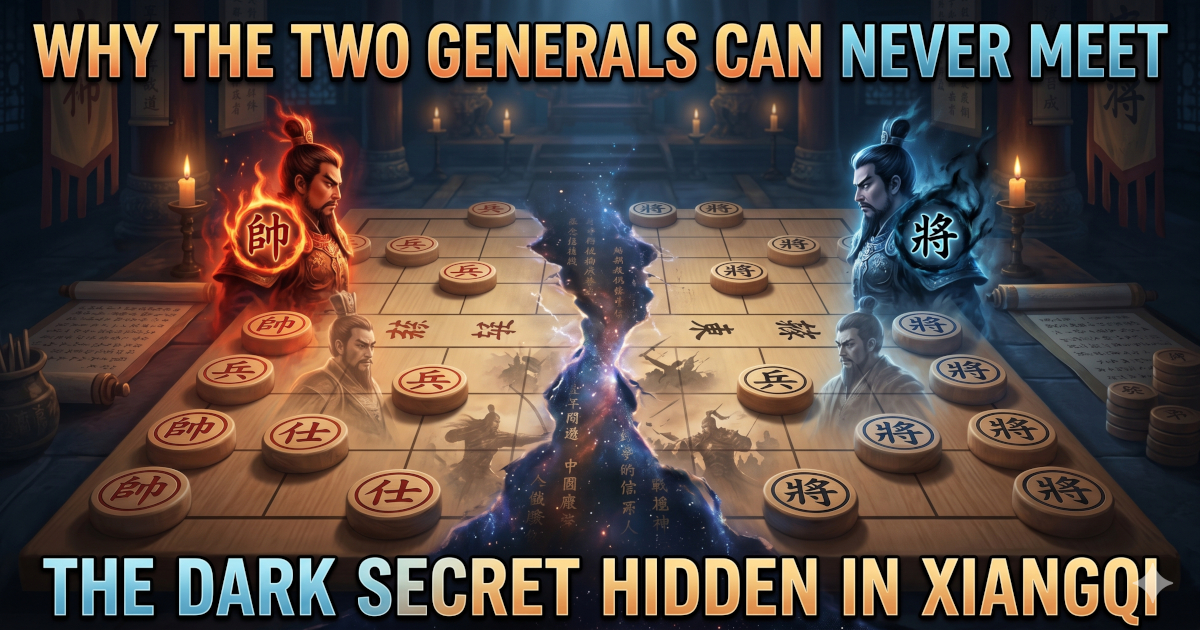
If you look closely at the middle of a traditional Xiangqi board, you will see a blank horizontal space dividing the two sides. Often, four Chinese characters are painted inside this space: 楚河漢界 (Chu He Han Jie), which translates to "Chu River, Han Border." This means that a game of Xiangqi is not an abstract fantasy battle. It is a historical reenactment of the Chu-Han Contention (206–202 BC), a brutal, five-year civil war that determined who would rule China after the collapse of the Qin Dynasty. On one side was Xiang Yu, the Hegemon-King of Western Chu—a terrifying, brilliant, and physically imposing warrior. On the other side was Liu Bang, the King of Han—a cunning, pragmatic, and charismatic leader who would eventually win the war and found the legendary Han Dynasty. The Xiangqi board perfectly mirrors this geopolitical standoff. And the Flying General rule? That comes directly from a tense, real-life encounter between these two legendary warlords.
The Dark Secret: The Sniper at Guangwu Gorge
In the year 203 BC, the war between Chu and Han had reached a grueling stalemate. The two massive armies found themselves entrenched on opposite sides of the Guangwu Gorge, a massive ravine in modern-day Henan province. A deep, rushing canal separated them, making a direct infantry assault impossible. For months, the two armies stared at each other across the chasm. Supplies were dwindling, and morale was breaking. According to the Records of the Grand Historian (Shiji) written by Sima Qian, the physically dominant Xiang Yu grew tired of the stalemate. He stepped out into the open, across the ravine from the Han encampment, and shouted a challenge to Liu Bang. Xiang Yu demanded that Liu Bang face him in single combat to decide the fate of the empire, sparing the blood of the peasants. Liu Bang, knowing he stood absolutely no chance in a physical fight against the towering Xiang Yu, laughed off the challenge. Instead, Liu Bang rode to the edge of the ravine, looked Xiang Yu in the eye, and loudly began to list the "Ten Great Crimes" Xiang Yu had committed against the empire, humiliating the Chu warlord in front of both armies. Enraged by the insults, Xiang Yu refused to listen any longer. Unbeknownst to Liu Bang, Xiang Yu had anticipated this exact scenario. He had secretly ordered a master crossbowman to hide in the shadows of the Chu encampment, tracking Liu Bang's movements. (Some historical accounts even suggest Xiang Yu grabbed the crossbow and took the shot himself).
As the two commanders stood face-to-face across the gorge, the crossbow fired. The heavy bolt flew across the ravine and struck Liu Bang square in the chest.
Liu Bang was critically wounded and nearly died. However, showing his own brand of cunning, Liu Bang grabbed his foot and screamed that the bolt had only hit his toe, hiding the fatal severity of the chest wound so his army's morale wouldn't collapse. He was hurriedly rushed into his tent to recover.
The Birth of the Rule
This treacherous moment at Guangwu Gorge is the exact historical origin of the Flying General rule in Xiangqi. Because Liu Bang was nearly assassinated when he exposed himself to the direct line of sight of the enemy warlord, the creators of Xiangqi immortalized the lesson on the board: A commander must never stand face-to-face with the enemy commander across an open field. If they do, an invisible crossbow bolt will strike them down. When you use the Flying General rule to win a game of Chinese Chess, you are not just executing a clever board game mechanic. You are firing Xiang Yu’s hidden crossbow.
How the Rule Changes Xiangqi Strategy
Understanding the dark history behind the rule is fascinating, but mastering how it changes the game is what makes a great Xiangqi player. The Flying General profoundly alters the tactical landscape in three distinct ways:
1. The General as an Attacking Weapon
In Western chess, the King is almost entirely defensive until the very end of the game when the board is mostly empty. In Xiangqi, because the General exerts an invisible "laser beam" of power, it can actively participate in the mid-game. By simply shifting your General to an open file, you can suddenly pin an enemy piece to their General, completely paralyzing their defense without risking any of your own attacking pieces.
2. The "Face-to-Face Laugh" Checkmate
One of the most common and devastating checkmates in Xiangqi is known colloquially as the Face-to-Face Laugh (or the "Opposite-Facing Generals" mate). This occurs when you use your General to control the center file. With the enemy General unable to step onto that file, you can move a Chariot (Rook) or a Pawn right up to the enemy General's face. Because your own General is providing "cover fire" from across the board, the enemy General cannot capture the attacking piece. It is a suffocating, inescapable checkmate.
3. The Ultimate Defensive Shield
If you find yourself under heavy attack, opening up a file to expose the enemy General can force your opponent to abandon their assault. They cannot move their attacking pieces if doing so would reveal their General to yours. The threat of the sniper's bolt forces them to retreat and cover their own commander.
Conclusion: A Game Steeped in History
Xiangqi is a masterpiece of game design because it perfectly marries mechanical balance with profound historical storytelling. Every time you set up the board, you are stepping back in time to the Chu River and the Han Border. The next time you play a game of Chinese Chess, pay close attention to your Palace. Keep your Advisors close, let your Elephants patrol the borders, and most importantly, keep an eye on the open files. Remember the dark secret of Guangwu Gorge, and never let the two Generals meet. The ghost of Xiang Yu's crossbowman is always waiting for a clear shot.
Comments (0)
You need to log in to join the discussion.
No comments yet. Be the first to share your thoughts!